Why a Medievalist Loves the Sagrada Família
Why a Medievalist Loves the Sagrada Família
Why a Medievalist Loves the Sagrada Família
SCROLL TO EXPLORE →
SCROLL TO EXPLORE →
I've been fascinated by the Sagrada Família since I first read about it at around eleven years old. The fact that it was still under construction — after more than a century — was mind-boggling to me. How does a building take that long? How does anyone keep going?
The Sagrada Família was begun in 1882, as the world was moving toward industrialization, secularization, and eventually the stripped-down functionalism that would define the twentieth century. Gaudí looked at that moment and went the other direction entirely — deeper into ornament, deeper into nature, deeper into theological intention.
He was solving the same problems the Gothic builders were solving: how do you hold up a very tall stone building, how do you fill it with light, how do you make the structure itself carry meaning. He just looked further back, past the medieval solutions, all the way to the forest. The result looks like nothing that came before it and is somehow deeply, recognizably connected to all of it.
The Crown
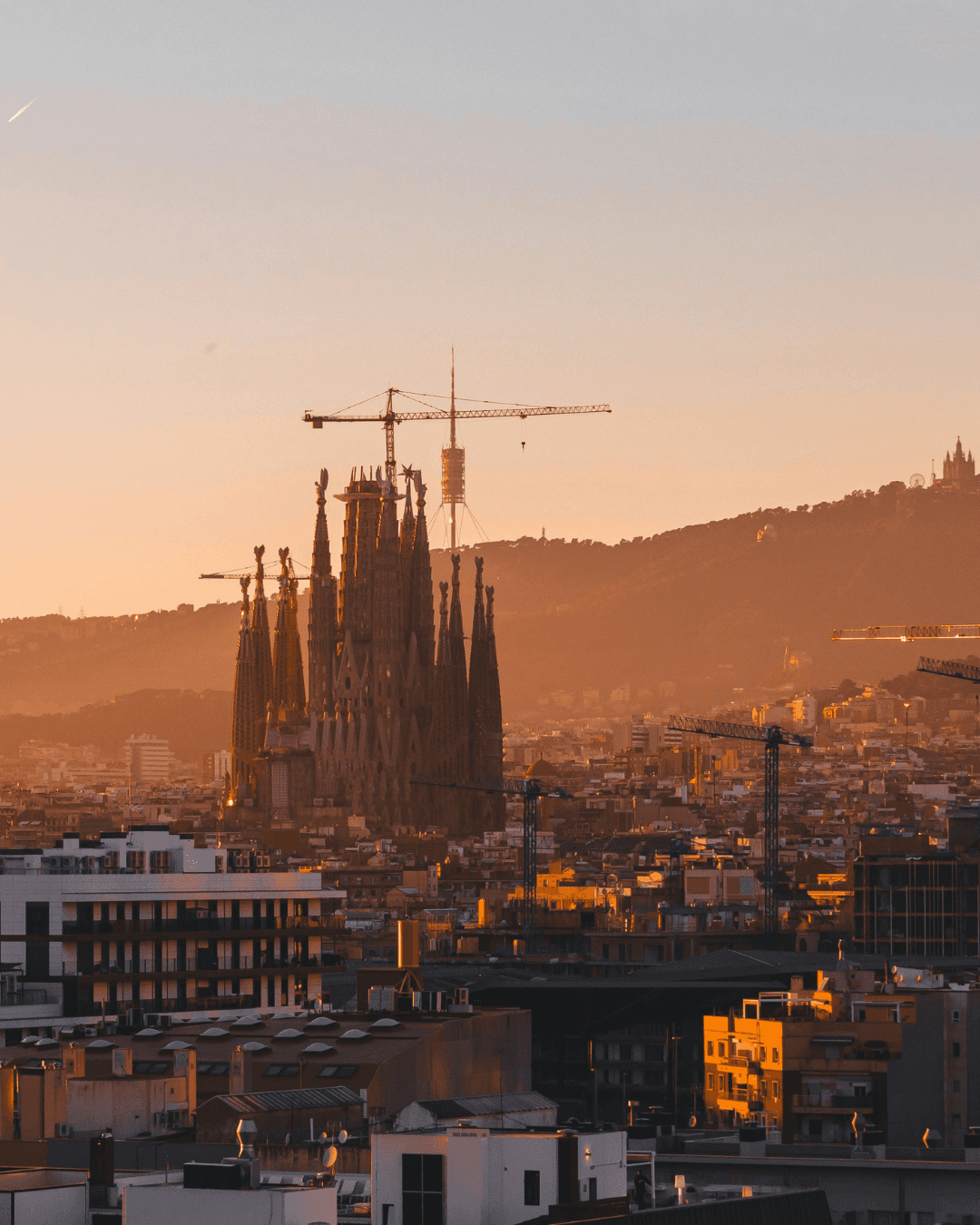
On February 20, 2026, the last piece of the central Tower of Jesus Christ was set in place atop the Sagrada Família in Barcelona. The church, still surrounded by cranes, still unfinished, became the tallest in the world at 172.5 meters. On June 10 — one month from today and exactly one hundred years after Antoni Gaudí's death — the tower will be formally crowned and inaugurated in a solemn Mass presided over by Pope Leo XIV.
Gaudí died in 1926, struck by a tram, buried in the crypt of his unfinished life's work. He had been living on the construction site for years by then, eating almost nothing, giving everything he had to a building he knew he would never see completed. He left behind plaster models and meticulous plans so that other hands could carry the work forward. He trusted them.
One hundred years later, they finished his sentence.
A Different Kind of Problem
What makes the Sagrada Família strange — and worth paying attention to as a designer — is that it doesn't look like anything else. Not because Gaudí was being eccentric, but because he wanted to look beyond accepted solutions for the problems this building posed.
Gothic cathedrals solved the problem of height with flying buttresses: external skeleton frameworks that push back against the outward thrust of the walls. They work, but they're a workaround. Gaudí looked at the problem differently. He looked at trees.
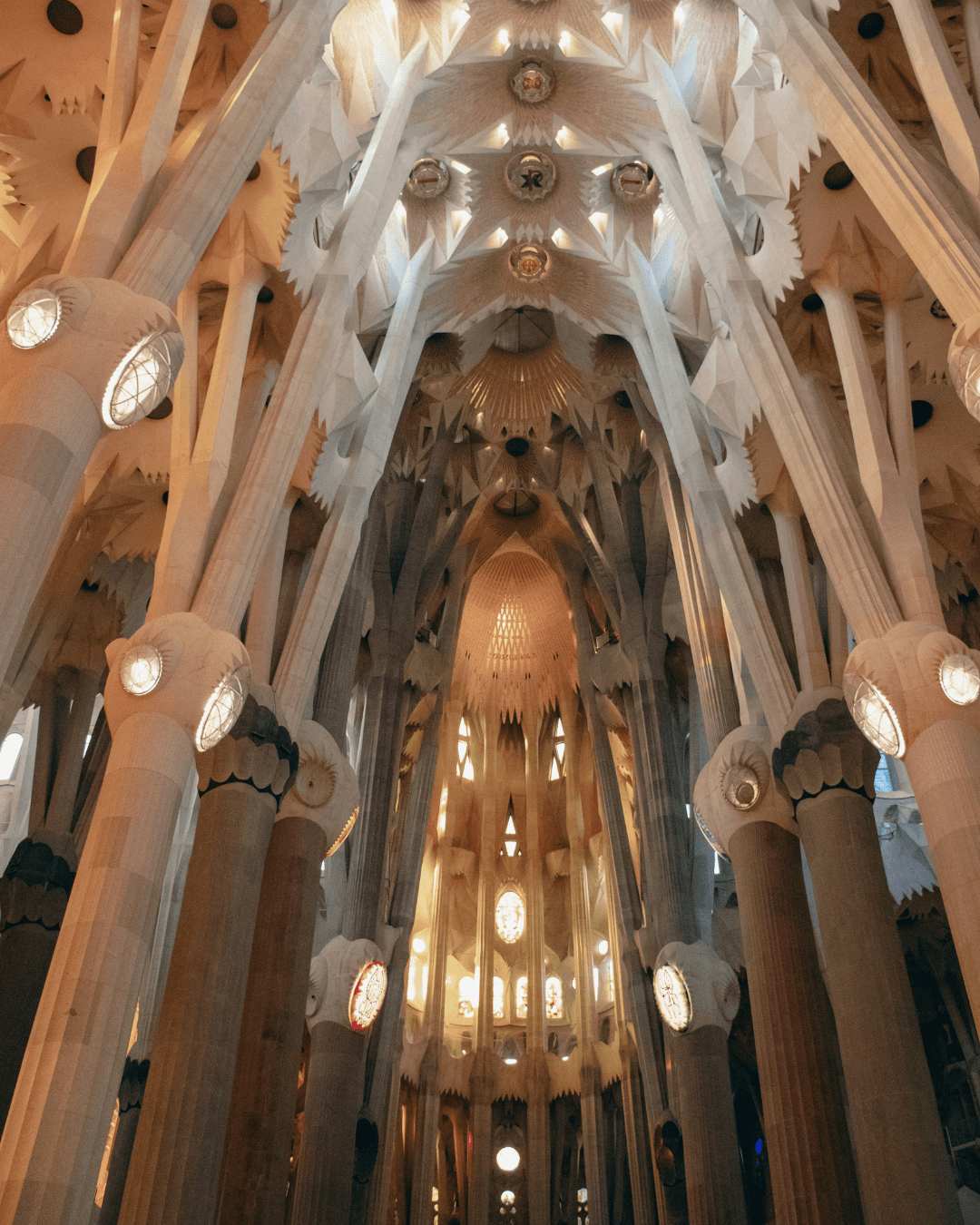
The interior columns of the Sagrada Família branch as they rise, distributing weight the way a forest canopy does — each fork transferring load downward through the structure until it reaches the ground. No buttresses needed. The building holds itself up the way a living thing does, from the inside out.
The curves are just as unconventional. Gaudí worked extensively with hyperboloids, paraboloids, and helicoids — geometric forms that sound impossibly complex but are everywhere in nature, like bones and nautilus shells. He built physical models of his structures upside down, letting gravity do the math, then photographed them inverted to see how they'd stand. The geometry was so advanced that it wasn't fully understood until computers could model it in the 1990s. He was working decades ahead of the tools that could explain what he was doing.
It calls to mind Brunelleschi and the dome of Santa Maria del Fiore in Florence — another architect facing a structural problem that had never been solved, who arrived at a solution so unprecedented that his contemporaries couldn't fully understand how it worked. The dome is essentially a medieval structural problem solved with Renaissance ingenuity. Brunelleschi built a double-shelled dome without centering, without the timber framework that convention demanded, and took the method largely to his grave. Gaudí left his models and plans, but the underlying geometry wasn't fully decoded until the age of computers. Both men were working at the edge of what their age could comprehend.
Built to Be Handed On
Gaudí also shares something with the anonymous architects of the great Gothic cathedrals — Chartres, Cologne, Notre Dame — who laid foundations they knew they would never see crowned. They designed anyway, with enough integrity in the logic that generations of craftsmen could find their way through it without losing the thread.
What I find remarkable is not the engineering feat, impressive as it is — but the instinct behind it. When Gaudí needed to solve a structural problem, he looked at how a tree solves it. When he needed a curve, he looked at a nautilus. Nature as the first blueprint, not as decoration applied afterward but as the logic underneath everything.
Light as Material
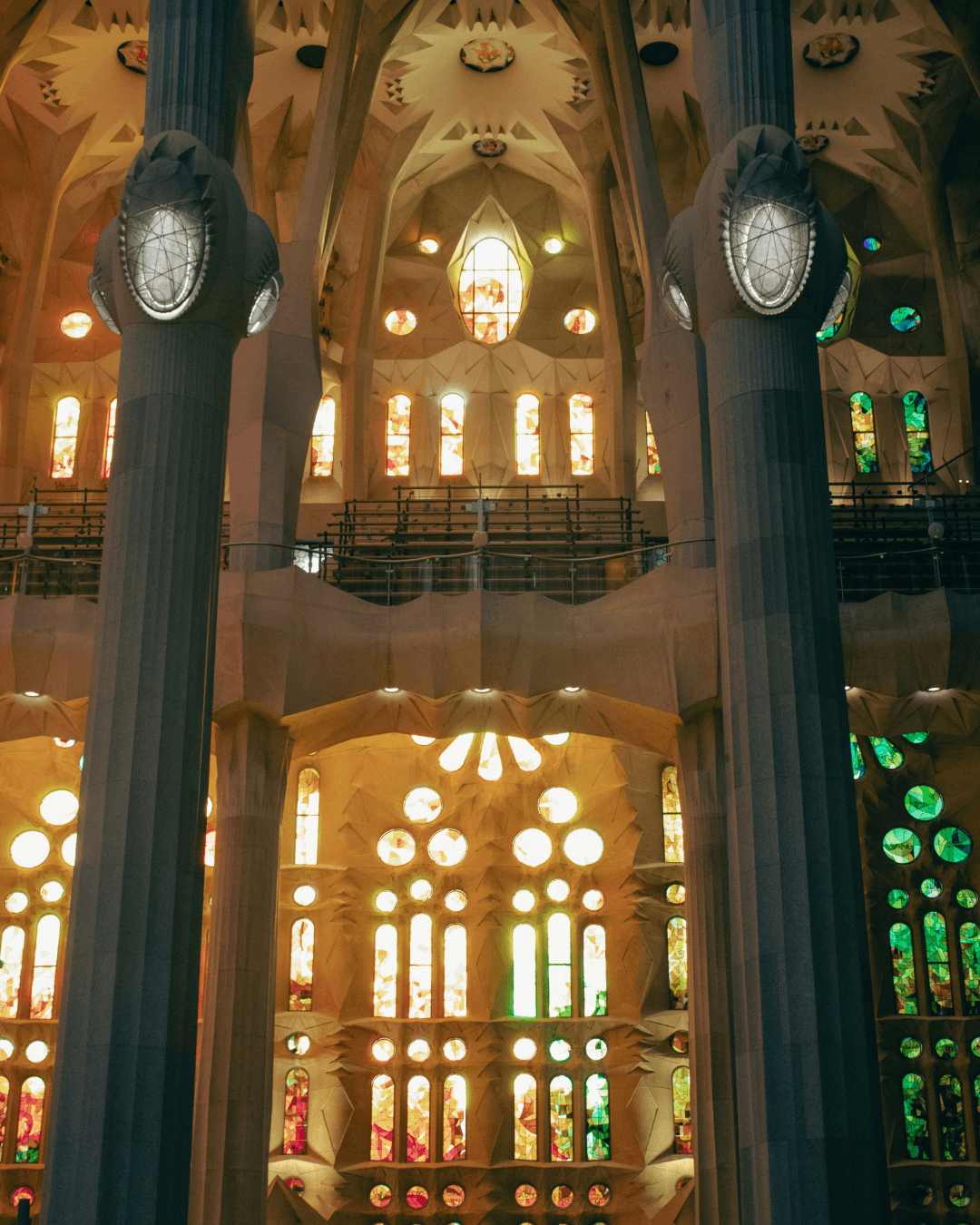
The stained glass windows of the Sagrada Família aren't decorative in the conventional sense — they're compositional. Gaudí specified warm ambers and reds on the western walls, cool blues and greens on the east, so that the quality of light inside the building shifts as the sun moves through the day. Morning feels different from evening. The space is never quite the same twice.
The columns, the curves, the light — none of it is ornament. It's all structure, all argument. Which brings us to what the building is actually arguing.
Gaudí called it a Bible in stone — a complete visual theology readable by anyone who walks through it. The three main façades tell the story of Christ in sequence: the Nativity façade, dense with life and plants and joyful carving, proclaims the Incarnation. The Passion façade is stark and angular, its figures gaunt and severe, asking you to feel the cost of redemption. The Glory façade, still being completed, looks toward eternal life.
The towers follow the same logic. Eighteen in total: twelve for the Apostles, four for the Evangelists, one for Mary, and at the center, Christ — the tallest, the crown.
144 Years
Which brings us back to June 10, and what it means that this building is finally, actually, nearly done.
144 years of construction. Dozens of architects, stonecutters, glass artists, engineers, and donors who knew they would never see the finished thing. Gaudí designed precisely for it — leaving models, leaving plans, leaving enough of the logic that others could continue the argument he had started.
There's something thought-provoking about that for a designer — or for anyone trying to build something that lasts. Good design isn't built for the moment it launches. It's built to be carried forward — by other hands, in contexts you can't anticipate, long after you've left the room. The goal isn't a beautiful thing. It's a coherent enough logic that the work can continue without you.
Gaudí understood that at a scale most of us will never approach. We live in a moment that rewards the new, the fast, the immediately legible. Trends arrive and are exhausted within a season. Gaudí was working on a completely different scale, with a completely different question: not what is resonant right now but what is true. He built accordingly. And 144 years later, the thing is still standing, still being completed, still drawing people in from across the world to stand under its branching columns and look up.
On June 10, in the centenary year of his death, the Tower of Jesus Christ will be blessed and inaugurated. The Pope will preside. The cranes will eventually come down. And a building 144 years in the making will finally say what it always meant to say — Christ at the summit, visible from across the city, exactly where Gaudí put him in his plans a century ago.
Sources: Sagrada Família Foundation (sagradafamilia.org) and sagradafamilia2026.org.
Images:
Sagrada Família at sunset, Barcelona. Photo by Boris Hadjur via Unsplash.
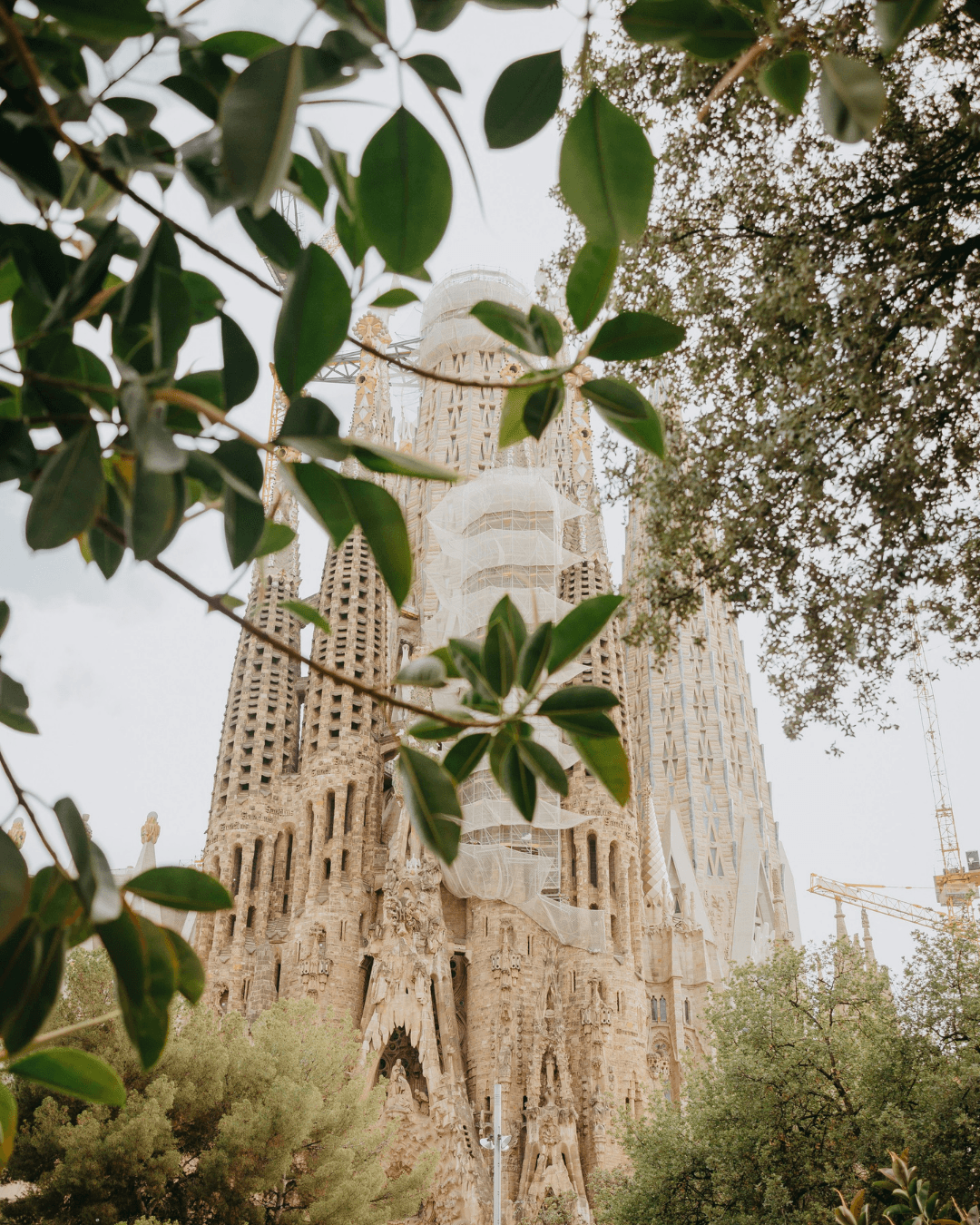
Sagrada Família exterior through tree branches. Photo by Barbora Likavska via Unsplash.
Interior columns of the Sagrada Família branching toward the vaulted ceiling. Photo by Gürkan Şen via Unsplash.
Stained glass windows inside the Sagrada Família, warm and cool tones side by side. Photo by Gürkan Şen via Unsplash.
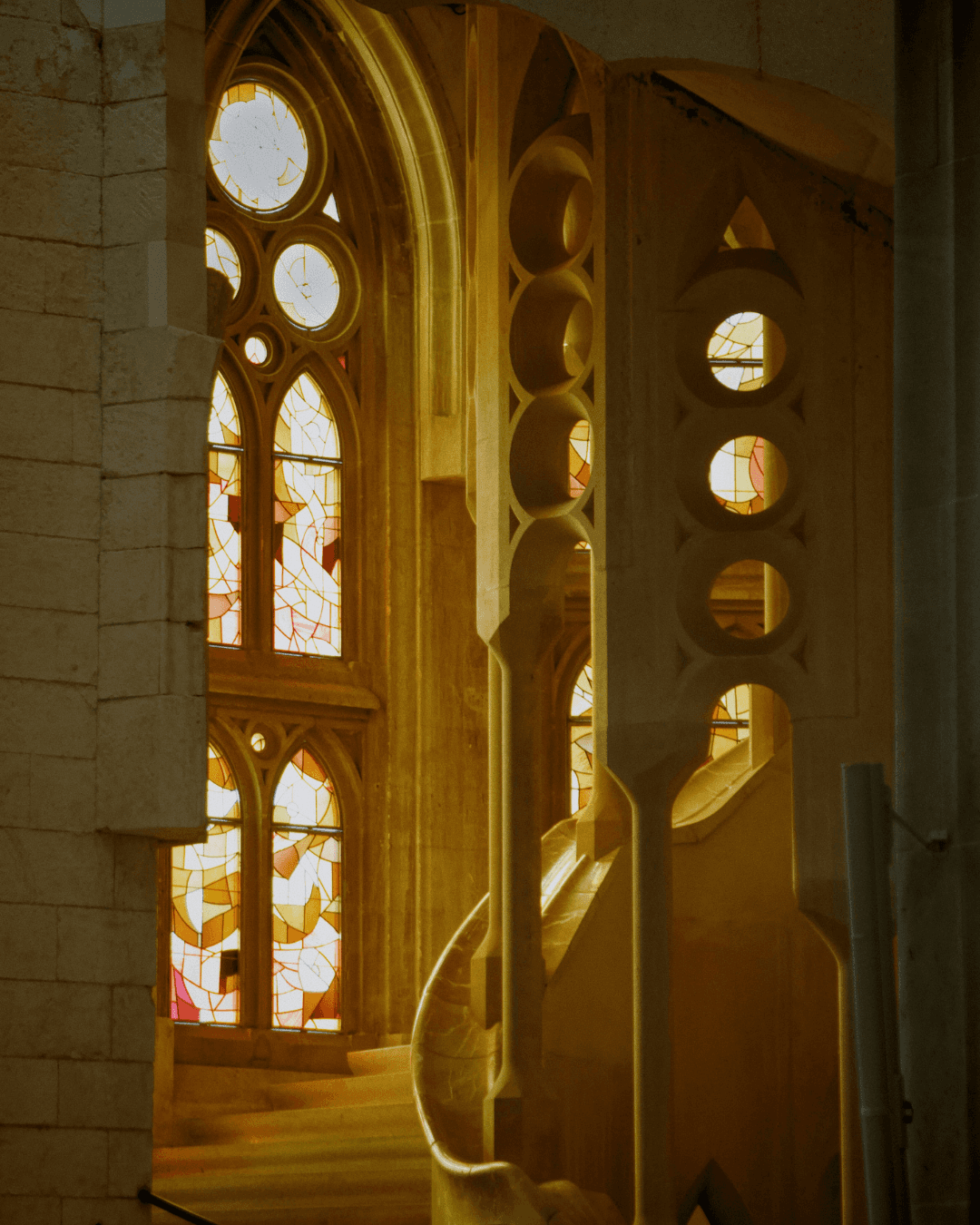
Interior staircase of the Sagrada Família bathed in warm golden light. Photo by Bo Zhang via Unsplash.
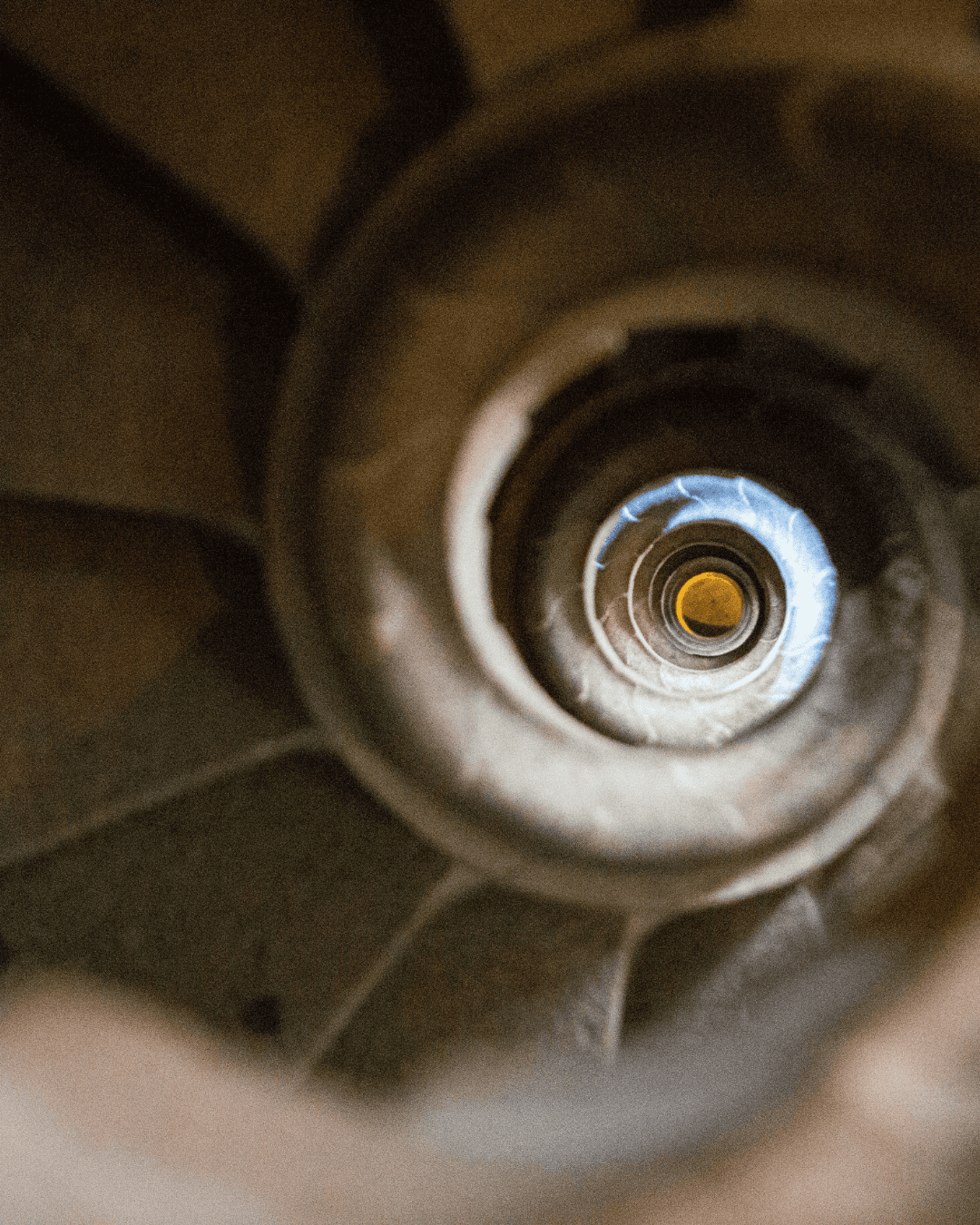
Spiral staircase inside the Sagrada Família viewed from above. Photo by Mark de Jong via Unsplash.
SCROLL TO EXPLORE →
I've been fascinated by the Sagrada Família since I first read about it at around eleven years old. The fact that it was still under construction — after more than a century — was mind-boggling to me. How does a building take that long? How does anyone keep going?
The Sagrada Família was begun in 1882, as the world was moving toward industrialization, secularization, and eventually the stripped-down functionalism that would define the twentieth century. Gaudí looked at that moment and went the other direction entirely — deeper into ornament, deeper into nature, deeper into theological intention.
He was solving the same problems the Gothic builders were solving: how do you hold up a very tall stone building, how do you fill it with light, how do you make the structure itself carry meaning. He just looked further back, past the medieval solutions, all the way to the forest. The result looks like nothing that came before it and is somehow deeply, recognizably connected to all of it.
The Crown
On February 20, 2026, the last piece of the central Tower of Jesus Christ was set in place atop the Sagrada Família in Barcelona. The church, still surrounded by cranes, still unfinished, became the tallest in the world at 172.5 meters. On June 10 — one month from today and exactly one hundred years after Antoni Gaudí's death — the tower will be formally crowned and inaugurated in a solemn Mass presided over by Pope Leo XIV.
Gaudí died in 1926, struck by a tram, buried in the crypt of his unfinished life's work. He had been living on the construction site for years by then, eating almost nothing, giving everything he had to a building he knew he would never see completed. He left behind plaster models and meticulous plans so that other hands could carry the work forward. He trusted them.
One hundred years later, they finished his sentence.
A Different Kind of Problem
What makes the Sagrada Família strange — and worth paying attention to as a designer — is that it doesn't look like anything else. Not because Gaudí was being eccentric, but because he wanted to look beyond accepted solutions for the problems this building posed.
Gothic cathedrals solved the problem of height with flying buttresses: external skeleton frameworks that push back against the outward thrust of the walls. They work, but they're a workaround. Gaudí looked at the problem differently. He looked at trees.
The interior columns of the Sagrada Família branch as they rise, distributing weight the way a forest canopy does — each fork transferring load downward through the structure until it reaches the ground. No buttresses needed. The building holds itself up the way a living thing does, from the inside out.
The curves are just as unconventional. Gaudí worked extensively with hyperboloids, paraboloids, and helicoids — geometric forms that sound impossibly complex but are everywhere in nature, like bones and nautilus shells. He built physical models of his structures upside down, letting gravity do the math, then photographed them inverted to see how they'd stand. The geometry was so advanced that it wasn't fully understood until computers could model it in the 1990s. He was working decades ahead of the tools that could explain what he was doing.
It calls to mind Brunelleschi and the dome of Santa Maria del Fiore in Florence — another architect facing a structural problem that had never been solved, who arrived at a solution so unprecedented that his contemporaries couldn't fully understand how it worked. The dome is essentially a medieval structural problem solved with Renaissance ingenuity. Brunelleschi built a double-shelled dome without centering, without the timber framework that convention demanded, and took the method largely to his grave. Gaudí left his models and plans, but the underlying geometry wasn't fully decoded until the age of computers. Both men were working at the edge of what their age could comprehend.
Built to Be Handed On
Gaudí also shares something with the anonymous architects of the great Gothic cathedrals — Chartres, Cologne, Notre Dame — who laid foundations they knew they would never see crowned. They designed anyway, with enough integrity in the logic that generations of craftsmen could find their way through it without losing the thread.
What I find remarkable is not the engineering feat, impressive as it is — but the instinct behind it. When Gaudí needed to solve a structural problem, he looked at how a tree solves it. When he needed a curve, he looked at a nautilus. Nature as the first blueprint, not as decoration applied afterward but as the logic underneath everything.
Light as Material
The stained glass windows of the Sagrada Família aren't decorative in the conventional sense — they're compositional. Gaudí specified warm ambers and reds on the western walls, cool blues and greens on the east, so that the quality of light inside the building shifts as the sun moves through the day. Morning feels different from evening. The space is never quite the same twice.
The columns, the curves, the light — none of it is ornament. It's all structure, all argument. Which brings us to what the building is actually arguing.
Gaudí called it a Bible in stone — a complete visual theology readable by anyone who walks through it. The three main façades tell the story of Christ in sequence: the Nativity façade, dense with life and plants and joyful carving, proclaims the Incarnation. The Passion façade is stark and angular, its figures gaunt and severe, asking you to feel the cost of redemption. The Glory façade, still being completed, looks toward eternal life.
The towers follow the same logic. Eighteen in total: twelve for the Apostles, four for the Evangelists, one for Mary, and at the center, Christ — the tallest, the crown.
144 Years
Which brings us back to June 10, and what it means that this building is finally, actually, nearly done.
144 years of construction. Dozens of architects, stonecutters, glass artists, engineers, and donors who knew they would never see the finished thing. Gaudí designed precisely for it — leaving models, leaving plans, leaving enough of the logic that others could continue the argument he had started.
There's something thought-provoking about that for a designer — or for anyone trying to build something that lasts. Good design isn't built for the moment it launches. It's built to be carried forward — by other hands, in contexts you can't anticipate, long after you've left the room. The goal isn't a beautiful thing. It's a coherent enough logic that the work can continue without you.
Gaudí understood that at a scale most of us will never approach. We live in a moment that rewards the new, the fast, the immediately legible. Trends arrive and are exhausted within a season. Gaudí was working on a completely different scale, with a completely different question: not what is resonant right now but what is true. He built accordingly. And 144 years later, the thing is still standing, still being completed, still drawing people in from across the world to stand under its branching columns and look up.
On June 10, in the centenary year of his death, the Tower of Jesus Christ will be blessed and inaugurated. The Pope will preside. The cranes will eventually come down. And a building 144 years in the making will finally say what it always meant to say — Christ at the summit, visible from across the city, exactly where Gaudí put him in his plans a century ago.
Sources: Sagrada Família Foundation (sagradafamilia.org) and sagradafamilia2026.org.
Images:
Sagrada Família at sunset, Barcelona. Photo by Boris Hadjur via Unsplash.
Sagrada Família exterior through tree branches. Photo by Barbora Likavska via Unsplash.
Interior columns of the Sagrada Família branching toward the vaulted ceiling. Photo by Gürkan Şen via Unsplash.
Stained glass windows inside the Sagrada Família, warm and cool tones side by side. Photo by Gürkan Şen via Unsplash.
Interior staircase of the Sagrada Família bathed in warm golden light. Photo by Bo Zhang via Unsplash.
Spiral staircase inside the Sagrada Família viewed from above. Photo by Mark de Jong via Unsplash.
If this resonated, I'd love to send more of these your way.
The type on my site includes Perfectly Nineties Handwritten, Barnaby & Adelaide by Jen Wagner Type Co.
Shop with my link for exceptionally crafted fonts — use code jenrego15 for 15% off.




Based in Sacramento, California
© 2026 Jen Rego. All rights reserved.
Jen Rego
Jen Rego
Jen Rego
Based in Sacramento, California
Based in Sacramento, California
Based in Sacramento, California
The type on my site includes Perfectly Nineties Handwritten & Adelaide by Jen Wagner Type Co.
Shop with my link for exceptionally crafted fonts — use code jenrego15 for 15% off.
The type on my site includes
Perfectly Nineties Handwritten, Barnaby, & Adelaide
by Jen Wagner Type Co.
Shop with my link for exceptionally crafted fonts
— use code jenrego15 for 15% off.
The type on my site includes
Perfectly Nineties Handwritten, Barnaby & Adelaide by Jen Wagner Type Co.
Shop with my link for exceptionally crafted fonts — use code jenrego15 for 15% off.